Sunday, December 31, 2023

ARTICLES EXERCISE(GRAMMAR)

 Use ‘an’, ‘a’ or ‘the’ appropriately in the sentences given below.

  1. Sheldon is ___ honest man.
  2. King Arthur was ___ just king.
  3. ____ lion let go of ___ mouse.
  4. I have fixed ___ appointment with ___ doctor.
  5. Will you take ___ picture of us?
  6. I broke ___ vase my brother brought.
  7. My mother has ___ polka-dotted umbrella.
  8. The team organised __ friendly match with ___ Presidents of both ___ countries.
  9. We had __ mulberry tree in the garden.
  10. ___ Eiffel Tower lights up at night.
  11. ___ huge building turned to dust due to __ earthquake.
  12. ___ famous band Beatles is coming to Texas tomorrow.
  13. Charles Babbage is considered as ___ father of computers.
  14. __ famous poem ‘Ode to a Nightingale’ is written by __ Romantic poet John Keats.
  15. __ Pacific Ocean is one of __ five oceans of __ world.
  16. __ painter drew __ life-sized portrait of Mrs Mary Poppins.
  17. My son is ___ apple of my eye.
  18. ___ history professor who taught us is retiring today.
  19. ___ oranges I brought were very sour.
  20. Sharon will take __ train from __ next stop

comment
let me know your score 

IMPORTANT QUESTION (CHEMISTRY) CLASS 12

 IMPORTANT QUESTION (CHEMISTRY) 

BY AARISH SIR 

1. What is standard hydrogen electrode? How is it made?


2. What is Kohlrausch law? Give any one of its applications?


3. Describe Brodie's ozonizer with diagram


4. Write formulas and structures of five oxy acids of sulphur


5. Write short notes on the following:


Lucas Reagent


Reimer-Tiemann Reaction


6. Write short notes on the following:


Charak


Nalanda Vishwa Vistrala


7. Give any 4 differences between Phenol and Alcohol


8. What is Tyndall effect?


9. What are Interhalogen Compounds?


10. Write short notes on:


Threshold Energy


Energy of Activation


11. Write 4 Alloys of Aluminium with its names, composition and its uses 12. Difference between primary, secondary and tertiary alcohol through victor meyer's


Method only Equations


13. Write electro-chemical theory of corrosion(Rust)


14. What is gold number?


15. What is emulsion?


16. Why the elements of Group 17 are coloured?


17. Write any two applications of Enzymes


18. What is ionization isomerism? Give one example


19. What half life period of a reaction? Calculate the half life period of a first order reaction.


20. Draw a labelled diagram of a blast furnace for the extraction of iron

IMPORTANT QUESTIONS OF BIOLOGY CLASS 12

 Important questions BY AARISH SIR (BIOLOGY) 

1 Write differences between Trachiole and bronchiole


2. Write any two advantages and two disadvantages of self pollination


3. What is a test tube baby


4. Define the following:


5. Osmotic Pressure


(b) Suction Pressure


(c) Root Pressure


6. What do you understand by Yogasana Write it's two advantages?


7. Write any 4 differences between Tendon and Ligaments


8. Draw a labelled diagram of T.S. of Plant Ovule


9. What is mimicry? Write its types


10. Explain any common 4 problems of Adolescence


11. Explain in Reflex Action with diagram


12. Why does muscle fatigue happen?


13. Write the difference between clinical death and biological death


14. What are sex hormones? Describe one male and one female sex hormon


15. Explain any 5 stages of Hydrosere


16. Write any 3 application of biotechnology in the field of agriculture


17 Draw a labelled diagram of pollen grain


18 Write any two important difference between short day plants and long day


19 Write only the name of different stages Mechanism of human reproduction


20 Explain the 4 adaptation of xerophyte


21 Describe cabin cycle with Ray Diagram

Important Questions of MP Board Class 12 Physics

 Important Questions of MP Board Class 12 Physics By AARISH SIR 


1 Define Remote Sensing


2 Define Conjugate Focci


3. Give 2 characteristics of laser rays


4. If the length of a conducting wire becomes twice, when stretched Then, how many times, resistance will increase Calculate?


5. What is a thermistor? Wile the uses


6 What is a superconductor? Write the uses


7 Define the formula for refractive index of material of prism


8. With the help of Biot-Severt's law, obtain an expression for the intensity of magnetic field near a straight, long current carrying conductor


9 What are electromagnetic waves. Write their charactenstics( any six)


10 What is a communication system? What are the main parts of it, explain with the help of a block diagram


11. State and Prove Gauss's Theorem


12 What is the greenhouse effect? Explain


13 What is photoelectic effect?


14 What is demodulation?


15 Derive expression for the self inductance of a solenoid What factors affect it?


16 Differentiate Analog signal and digital signal with diagrams


17 What is Parallax? Explain


18 What is Optical Fibre? On What Principle Does It Work?


19 Write Faraday's Laws of Electromagnetic Induction and obtain an expression of induced e.m.f


20 Describe the terrestrial telescope on the basis of the following point 


Important Questions (BIOLOGY) CLASS 12(M.P BOARD) ALL CHAPTERS

 Important questions (BIOLOGY) CLASS 12 BY AARISH SIR 

ट्रेकियोल और ब्रॉन्कियोल के बीच अंतर लिखें


सेल्फ पॉलिनेशन के दो लाभ और दो हानियाँ लिखें


टेस्ट ट्यूब बेबी क्या है?


निम्नलिखित को परिभाषित करें:


ओस्मोटिक प्रेशर


(बी) सक्शन प्रेशर


(सी) रूट प्रेशर


योगासन से आप क्या समझते हैं? इसके दो लाभ लिखें।


टेंडन और लिगामेंट्स के बीच 4 अंतर लिखें


प्लांट ओव्यूल के T.S. का लेबल डायग्राम बनाएं


मिमिक्री क्या है? इसके प्रकार लिखें


किशोरावस्था की सामान्य 4 समस्याएं समझाएं


डायग्राम के साथ रिफ्लेक्स क्रिया को समझाएं


मांसपेशियों का थकान क्यों होता है?


क्लिनिकल मौत और जैविक मौत के बीच अंतर लिखें


लैंगिक हार्मोन क्या होते हैं? एक पुरुष और एक महिला लैंगिक हार्मोन का वर्णन करें


हाइड्रोसीर के 5 चरणों को समझाएं


कृषि के क्षेत्र में जैव प्रौद्योगिकी के 3 अनुप्रयोग लिखें


पोलिन ग्रेन का एक लेबल्ड डायग्राम बनाएं


छोटे दिन के पौधों और लंबे दिन के पौधों के बीच दो महत्वपूर्ण अंतर लिखें


मानव पुनर्निर्माण के विभिन्न चरणों का केवल नाम लिखें


क्षीरजन्तु के 4 अनुकूलन की विवेचना करें


रे डायग्राम के साथ कैबिन साइकिल का विवरण करें

CLASS 10 Important Questions OF CHAPTER 8 (TRIGONOMETRY) NCERT

 Question. 1 : In ∆ ABC, right-angled at B, AB = 24 cm, BC = 7 cm.


Determine:
(i) sin A, cos A
(ii) sin C, cos C

Solution:

In a given triangle ABC, right-angled at B = ∠B = 90°

Given: AB = 24 cm and BC = 7 cm

That means, AC = Hypotenuse

According to the Pythagoras Theorem,

In a right-angled triangle, the squares of the hypotenuse side are equal to the sum of the squares of the other two sides.

By applying the Pythagoras theorem, we get

AC= AB+ BC2

AC2 = (24)+ 72

AC2 = (576 + 49)

AC2 = 625 cm2

Therefore, AC = 25 cm

(i) We need to find Sin A and Cos A.

As we know, sine of the angle is equal to the ratio of the length of the opposite side and hypotenuse side. Therefore,

Sin A = BC/AC = 7/25

Again, the cosine of an angle is equal to the ratio of the adjacent side and hypotenuse side. Therefore,

cos A = AB/AC = 24/25

(ii) We need to find Sin C and Cos C.

Sin C = AB/AC = 24/25

Cos C = BC/AC = 7/25

Question 2: If Sin A = 3/4, Calculate cos A and tan A.

Solution: Let us say, ABC is a right-angled triangle, right-angled at B.

Sin A = 3/4

As we know,

Sin A = Opposite Side/Hypotenuse Side = 3/4


Now, let BC be 3k and AC will be 4k.

where k is the positive real number.

As per the Pythagoras theorem, we know;

Hypotenuse2 = Perpendicular2+ Base2

AC2 = AB2 + BC2

Substitute the value of AC and BC in the above expression to get;

(4k)2 = (AB)2 + (3k)2

16k2 – 9k2 = AB2

AB2 = 7k2

Hence, AB = √7 k 

Now, as per the question, we need to find the value of cos A and tan A.

cos A = Adjacent Side/Hypotenuse side = AB/AC

cos A = √7 k/4k = √7/4

And,

tan A = Opposite side/Adjacent side = BC/AB

tan A = 3k/√7 k = 3/√7

Question.3: If ∠A and ∠B are acute angles such that cos A = cos B, then show that ∠ A = ∠ B.

Solution:

Suppose a triangle ABC, right-angled at C.


Now, we know the trigonometric ratios,

cos A = AC/AB

cos B = BC/AB

Since, it is given,

cos A = cos B

AC/AB = BC/AB

AC = BC

We know that by isosceles triangle theorem, the angles opposite to the equal sides are equal.

Therefore, ∠A = ∠B

Question 4: If 3 cot A = 4, check whether (1 – tan2A)/(1 + tan2A) = cos2 A – sin2 A or not.

Solution:

Let us consider a triangle ABC, right-angled at B.


Given,

3 cot A = 4

cot A = 4/3

Since, tan A = 1/cot A

tan A = 1/(4/3) = 3/4

BC/AB = 3/4

Let BC = 3k and AB = 4k

By using Pythagoras theorem, we get;

Hypotenuse2 = Perpendicular2 + Base2

AC2 = AB2 + BC2

AC2 = (4k)2 + (3k)2

AC2 = 16k+ 9k2

AC = 25k= 5k

sin A = Opposite side/Hypotenuse

= BC/AC

=3k/5k

=3/5

In the same way,

cos A = Adjacent side/hypotenuse

= AB/AC

= 4k/5k

= 4/5

To check: (1-tan2A)/(1+tan2A) = cos2 A – sin2 A or not

Let us take L.H.S. first;

(1-tan2A)/(1+tan2A) = [1 – (3/4)2]/ [1 + (3/4)2]

= [1 – (9/16)]/[1 + (9/16)] = 7/25

R.H.S. = cos2 A – sin2 A = (4/5)– (3/5)2

= (16/25) – (9/25) = 7/25

Since,

L.H.S. = R.H.S.

Hence, proved.

Question 5: In triangle PQR, right-angled at Q, PR + QR = 25 cm and PQ = 5 cm. Determine the values of sin P, cos P and tan P.

Solution: Given,

In triangle PQR,

PQ = 5 cm

PR + QR = 25 cm

Let us say, QR = x

Then, PR = 25 – QR = 25 – x


Using Pythagoras theorem:

PR2 = PQ2 + QR2

Now, substituting the value of PR, PQ and QR, we get;

(25 – x)2 = (5)2 + (x)2

25+ x– 50x = 25 + x2

625 – 50x = 25

50x = 600

x = 12

So, QR = 12 cm

PR = 25 – QR = 25 – 12 = 13 cm

Therefore,

sin P = QR/PR = 12/13

cos P = PQ/PR = 5/13

tan P = QR/PQ = 12/5

Question 6: Evaluate 2 tan2 45° + cos2 30° – sin2 60°.

Solution: Since we know,

tan 45° = 1

cos 30° = 3/2

sin 60° = 3/2

Therefore, putting these values in the given equation:

2(1)2 + (3/2)2 – (3/2)2

= 2 + 0

= 2

Question 7: If tan (A + B) =√3 and tan (A – B) =1/√3, 0° < A + B ≤ 90°; A > B, find A and B.

Solution: Given,

tan (A + B) = √3

As we know, tan 60° = √3

Thus, we can write;

⇒ tan (A + B) = tan 60°

⇒(A + B) = 60° …… (i)

Now again given;

tan (A – B) = 1/√3

Since, tan 30° = 1/√3

Thus, we can write;

⇒ tan (A – B) = tan 30°

⇒(A – B) = 30° ….. (ii)

Adding the equation (i) and (ii), we get;

A + B + A – B = 60° + 30°

2A = 90°

A= 45°

Now, put the value of A in eq. (i) to find the value of B;

45° + B = 60°

B = 60° – 45°

B = 15°

Therefore A = 45° and B = 15°

Question 8: Show that :

(i) tan 48° tan 23° tan 42° tan 67° = 1

(ii) cos 38° cos 52° – sin 38° sin 52° = 0

Solution:

(i) tan 48° tan 23° tan 42° tan 67°

We can also write the above given tan functions in terms of cot functions, such as;

tan 48° = tan (90° – 42°) = cot 42°

tan 23° = tan (90° – 67°) = cot 67°

Hence, substituting these values, we get

= cot 42° cot 67° tan 42° tan 67°

= (cot 42° tan 42°) (cot 67° tan 67°)

= 1 × 1 [since cot A.tan A = 1]

= 1

(ii) cos 38° cos 52° – sin 38° sin 52°

We can also write the given cos functions in terms of sin functions.

cos 38° = cos (90° – 52°) = sin 52°

cos 52°= cos (90° – 38°) = sin 38°

Hence, putting these values in the given equation, we get;

sin 52° sin 38° – sin 38° sin 52° = 0

Question 9: If tan 2A = cot (A – 18°), where 2A is an acute angle, find the value of A.

Solution: Given,

tan 2A = cot (A – 18°)

As we know by trigonometric identities,

tan 2A = cot (90° – 2A)

Substituting the above equation in the given equation, we get;

⇒ cot (90° – 2A) = cot (A – 18°)

Therefore,

⇒ 90° – 2A = A – 18°

⇒ 108° = 3A

A = 108° / 3

Hence, the value of A = 36°

Question 10:  If A, B and C are interior angles of a triangle ABC, then show that sin [(B + C)/2] = cos A/2.

Solution:

As we know, for any given triangle, the sum of all its interior angles is equals to 180°.

Thus,

A + B + C = 180° ….(1)

Now we can write the above equation as;

⇒ B + C = 180° – A

Dividing by 2 on both the sides;

⇒ (B + C)/2 = (180° – A)/2

⇒ (B + C)/2 = 90° – A/2

Now, put sin function on both sides.

⇒ sin (B + C)/2 = sin (90° – A/2)

Since,

sin (90° – A/2) = cos A/2

Therefore,

sin (B + C)/2 = cos A/2

Question 11: Prove the identities:

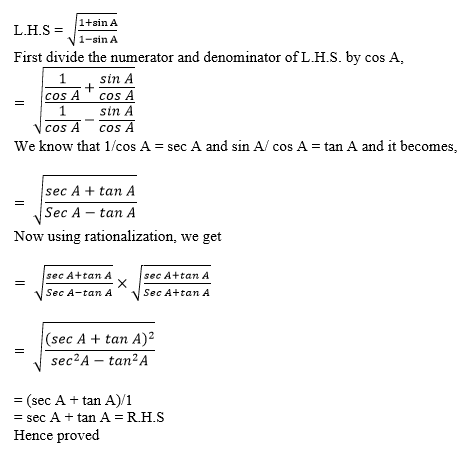
(i) √[1 + sinA/1 – sinA] = sec A + tan A

(ii) (1 + tan2A/1 + cot2A) = (1 – tan A/1 – cot A)2 = tan2A
Solution:
(i) Given:√[1 + sinA/1 – sinA] = sec A + tan A

Important Question Class 10 maths chapter 8
(ii) Given: (1 + tan2A/1 + cot2A) = (1 – tan A/1 – cot A)2 = tan2A

LHS:
= (1+tan²A) / (1+cot²A)
Using the trigonometric identities we know that 1+tan²A = sec²A and 1+cot²A= cosec²A
= sec²A/ cosec²A
On taking the reciprocals we get
= sin²A/cos²A
= tan²A
RHS:
=(1-tanA)²/(1-cotA)²
Substituting the reciprocal value of tan A and cot A we get,
= (1-sinA/cosA)²/(1-cosA/sinA)²
= [(cosA-sinA)/cosA]²/ [(sinA-cos)/sinA)²] = [(cosA-sinA)²×sin²A] /[cos²A. /(sinA-cosA)²] =  sin²A/cos²A
= tan2A
The values of LHS and RHS are the same.
Hence proved.

Question 12: If sin θ + cos θ = √3, then prove that tan θ + cot θ = 1.

Solution:

Given,

sin θ + cos θ = √3

Squaring on both sides,

(sin θ + cos θ)2 = (√3)2

sin2θ + cos2θ + 2 sin θ cos θ = 3

Using the identity sin2A + cos2A = 1,

1 + 2 sin θ cos θ = 3

2 sin θ cos θ = 3 – 1

2 sin θ cos θ = 2

sin θ cos θ = 1

sin θ cos θ = sin2θ + cos2θ

⇒ (sin2θ + cos2θ)/(sin θ cos θ) = 1

⇒ [sin2θ/(sin θ cos θ)] + [cos2θ/(sin θ cos θ)] = 1

⇒ (sin θ/cos θ) + (cos θ/sin θ) = 1

⇒ tan θ + cot θ = 1

Hence proved.

Question 13: Express cot 85° + cos 75° in terms of trigonometric ratios of angles between 0° and 45°.

Solution:

cot 85° + cos 75° 

= cot (90° – 5°) + cos (90° – 15°) 

We know that cos(90° – A) = sin A and cot(90° – A) = tan A

= tan 5° + sin 15°

Question 14: What is the value of (cos267° – sin223°)?

Solution:

(cos267° – sin223°) = cos2(90° – 23°) – sin223°

We know that cos(90° – A) = sin A

= sin223° – sin223°

= 0

Therefore, (cos267° – sin223°) = 1.

Question 15: Prove that (sin A – 2 sin3A)/(2 cos3A – cos A) = tan A.

Solution:

LHS = (sin A – 2 sin3A)/(2 cos3A – cos A)

= [sin A(1 – 2 sin2A)]/ [cos A(2 cos2A – 1]

Using the identity sin2θ + cos2θ = 1,

= [sin A(sin2A + cos2A – 2 sin2A)]/ [cos A(2 cos2A – sin2A – cos2A]

= [sin A(cos2A – sin2A)]/ [cos A(cos2A – sin2A)]

= sin A/cos A

= tan A

= RHS

Hence proved.


CLASS 10 Important Questions OF CHAPTER 7 (Coordinate Geometry) NCERT


Important Questions For Class 10 Maths Chapter 7 Coordinate Geometry

AARISH SIR

Q. 1: Find the distance of the point P (2, 3) from the x-axis.

Solution:

We know that,

(x, y) = (2, 3) is a point on the Cartesian plane in the first quadrant.

x = Perpendicular distance from y-axis

y = Perpendicular distance from x-axis

Therefore, the perpendicular distance from x-axis = y coordinate = 3

Q. 2: Find a relation between x and y such that the point (x, y) is equidistant from the points (7, 1) and (3, 5).

Solution:

Let P(x, y) be equidistant from the points A(7, 1) and B(3, 5).

Then, AP = BP

AP2 = BP2

Using distance formula,

(x – 7)2 + (y – 1)2 = (x – 3)2 + (y – 5)2

x2 – 14x + 49 + y2 – 2y + 1 = x2 – 6x + 9 + y2 – 10y + 25

x – y = 2

Hence, the relation between x and y is x – y = 2.

Q. 3: Find the coordinates of the points of trisection (i.e., points dividing into three equal parts) of the line segment joining the points A(2, – 2) and B(– 7, 4).

Solution:

Let P and Q be the points of trisection of AB, i.e., AP = PQ = QB.


Therefore, P divides AB internally in the ratio 1: 2.

Let (x1, y1) = (2, -2)

(x2, y2) = (-7, 4)

m1 : m2 = 1 : 2

Therefore, the coordinates of P, by applying the section formula,

(12+211+2,12+211+2)

=1(−7)+2(2)1+2,1(4)+2(−2)1+2

= (-3/3, 0/3)

= (-1, 0)

Similarly, Q also divides AB internally in the ratio 2 : 1. and the coordinates of Q by applying the section formula,

=2(−7)+1(2)2+1,2(4)+1(−2)2+1

= (-12/3, 6/3)

= (-4, 2)

Hence, the coordinates of the points of trisection of the line segment joining A and B are (–1, 0) and (– 4, 2).

Q. 4: Find the ratio in which the line segment joining the points (– 3, 10) and (6, – 8) is divided by (– 1, 6).

Solution:

Let the ratio in which the line segment joining ( -3, 10) and (6, -8) is divided by point ( -1, 6) be k:1.

Therefore by section formula,

(��2+1+1,��2+1+1)

-1 = ( 6k-3)/(k+1)

–k – 1 = 6k -3

7k = 2

k = 2/7

Hence, the required ratio is 2 : 7.

Q. 5: Find the value of k if the points A(2, 3), B(4, k) and C(6, –3) are collinear.

Solution:

Given,

A(2, 3)= (x1, y1)

B(4, k) = (x2, y2)

C(6, -3) = (x3, y3)

If the given points are collinear, the area of the triangle formed by them will be 0.

½ [x1(y2 – y3) + x2(y3 – y1) + x3(y1 – y2)] = 0

½ [2(k + 3) + 4(-3 -3) + 6(3 – k)] = 0

½ [2k + 6 – 24 + 18 – 6k] = 0

½ (-4k) = 0

4k = 0

k = 0

Q. 6: Find the area of the triangle formed by joining the mid-points of the sides of the triangle whose vertices are (0, –1), (2, 1) and (0, 3). Find the ratio of this area to the area of the given triangle.

Solution:

Let the vertices of the triangle be A(0, -1), B(2, 1) and C(0, 3).

Let D, E, F be the mid-points of the sides of this triangle.

Using the mid-point formula, coordinates of D, E, and F are:

D = [(0+2)/2, (-1+1)/2] = (1, 0)

E = [(0+0)/2, (-1+3)/2] = (0, 1)

F = [(0+2)/2, (3+1)/2] = (1, 2)


We know that,

Area of triangle = ½ [x1(y2 – y3) + x2(y3 – y1) + x3(y1 – y2)]

Area of triangle DEF = ½ {(1(2 – 1) + 1(1 – 0) + 0(0 – 2)}

= ½ (1 + 1)

= 1

Area of triangle DEF = 1 sq.unit

Area of triangle ABC = ½ {0(1 – 3) + 2(3 – (-1)) + 0(-1 – 1)}

= ½ (8)

= 4

Area of triangle ABC = 4 sq.units

Hence, the ratio of the area of triangle DEF and ABC = 1 : 4.

Q. 7: Name the type of triangle formed by the points A (–5, 6), B (–4, –2) and C (7, 5).

Solution:

The points are A (–5, 6), B (–4, –2) and C (7, 5).

Using distance formula,

d = √ ((x2 – x1)2 + (y2 – y1)2)

AB = √((-4+5)² + (-2-6)²)

= √(1+64)

=√65

BC=√((7+4)² + (5+2)²)

=√(121 + 49)

=√170

AC=√((7+5)² + (5-6)²)

=√144 + 1

=√145

Since all sides are of different lengths, ABC is a scalene triangle.

Q.8: Find the area of triangle PQR formed by the points P(-5, 7), Q(-4, -5) and R(4, 5).

Solution:

Given,

P(-5, 7), Q(-4, -5) and R(4, 5)

Let P(-5, 7) = (x1, y1)

Q(-4, -5) = (x2, y2)

R(4, 5) = (x3, y3)

Area of the triangle PQR = (½)|x1(y2 – y3) + x2(y3 – y1) + x3(y1 – y2)|

= (½) |-5(-5 – 5) + (-4)(5 – 7) + 4(7 + 5)|

= (½) |-5(-10) -4(-2) + 4(12)|

= (½) |50 + 8 + 48|

= (½) × 106

= 53

Therefore, the area of triangle PQR is 53 sq. units.

Q.9: If the point C(-1, 2) divides internally the line segment joining A(2, 5) and B(x, y) in the ratio 3 : 4, find the coordinates of B.

Solution:

Given,

C(-1, 2) divides internally the line segment joining A(2, 5) and B(x, y) in the ratio 3 : 4.

Here,

A(2, 5) = (x1, y1

B(x, y) = (x2, y2)

m : n = 3 : 4

Using section formula,

C(-1, 2) = [(mx2 + nx1)/(m + n), (my2 + ny1)/(m + n)]

= [(3x + 8)/(3 + 4), (3y + 20)/(3 + 7)]

By equating the corresponding coordinates,

(3x + 8)/7 = -1

3x + 8 = -7

3x = -7 – 8

3x = -15

x = -5

And

(3y + 20)/7 = 2

3y + 20 = 14

3y = 14 – 20

3y = -6

y = -2

Therefore, the coordinates of B(x, y) = (-5, -2).

Q.10: Find the ratio in which the line x – 3y = 0 divides the line segment joining the points (-2, -5) and (6, 3). Find the coordinates of the point of intersection.

Solution:

Let the given points be:

A(-2, -5) = (x1, y1)

B(6, 3) = (x2, y2)

The line x – 3y = 0 divides the line segment joining the points A and B in the ratio k : 1.

Using section formula,

Point of division P(x, y) = [(kx2 + x1)/(k + 1), (ky2 + y1)/(k + 1)]

x = (6k – 2)/(k + 1) and y = (3k – 5)/(k + 1)

Here, the point of division lies on the line x – 3y = 0.

Thus,

[(6k – 2)/(k + 1)] – 3[(3k – 5)/(k + 1)] = 0

6k – 2 – 3(3k – 5) = 0

6k – 2 – 9k + 15 = 0

-3k + 13 = 0

-3k = -13

k = 13/3

Thus, the ratio in which the line x – 3y = 0 divides the line segment AB is 13 : 3.

Therefore, x = [6(13/3) – 2]/ [(13/3) + 1]

= (78 – 6)/(13 + 3)

= 72/16

= 9/2

And

y = [3(13/3) – 5]/ [(13/3) + 1]

= (39 – 15)/(13 + 3)

= 24/16

= 3/2

Therefore, the coordinates of the point of intersection = (9/2, 3/2).

Q.11: Write the coordinates of a point on the x-axis which is equidistant from points A(-2, 0) and B(6, 0).

Solution:

Let P(x, 0) be a point on the x-axis.

Given that point, P is equidistant from points A(-2, 0) and B(6, 0).

AP = BP

Squaring on both sides,

(AP)² = (BP)²

Using distance formula,

(x + 2)² + (0 – 0)² = (x – 6)² + (0 – 0)²

x² + 4x + 4 = x² – 12x + 36

4x + 12x = 36 – 4

16x = 32

x = 2

Therefore, the coordinates of a point on the x-axis = (2, 0).

Q.12: If A(-2, 1), B(a, 0), C(4, b) and D(1, 2) are the vertices of a parallelogram ABCD, find the values of a and b. Hence, find the lengths of its sides.

Solution:

Given vertices of a parallelogram ABCD are:

A(-2, 1), B(a, 0), C(4, b) and D(1, 2)

We know that the diagonals of a parallelogram bisect each other.

So, midpoint of AC = midpoint of BD

[(-2 + 4)/2, (1 + b)/2] = [(a + 1)/2, (0 + 2)/2]

By equating the corresponding coordinates,

2/2 = (a + 1)/2 and (1 + b)/2 = 2/2

a + 1 = 2 and b + 1 = 2

a = 1 and b = 1

Therefore, a = 1 and b = 1.

Let us find the lengths of sides of a parallelogram, i.e. AB, BC, CD and DA

Using the distance formula,

AB = √[(1 + 2)² + (0 – 1)²] = √(9 + 1) = √10 units

BC = √[(4 – 1)² + (1 – 0)²] = √(9 + 1) = √10 units

And CD = √10 and DA = √10 {the opposite sides of a parallelogram are parallel and equal}

Hence, the length of each side of the parallelogram ABCD = √10 units.

Q.13: If A(-5, 7), B(-4, -5), C(-1, -6) and D(4, 5) are the vertices of a quadrilateral, find the area of the quadrilateral ABCD.

Solution:

Given vertices of a quadrilateral are:

A(-5, 7), B(-4, -5), C(-1, -6) and D(4, 5)

The quadrilateral ABCD can be divided into two triangles ABD and BCD.

Area of the triangle with vertices (x1, y1), (x2, y2), and (x3, y3) = (½) |x1(y2 – y3) + x2(y3 – y1) + x3(y1 – y2)|

Area of triangle ABD = (½) |-5(-5 – 5) + (-4)(5 – 7) + 4(7 + 5)|

= (½) |-5(-10) -4(-2) + 4(12)|

= (½) |50 + 8 + 48|

= (½) × 106

= 53

Area of triangle BCD = (½) |-4(-6 – 5) + (-1)(5 + 5) + 4(-5 + 6)|

= (½) |-4(-11) -1(10) + 4(1)|

= (½) |44 – 10 + 4|

= (½) × 38

= 19 

Therefore, the area of quadrilateral ABCD = Area of triangle ABD + Area of triangle BCD

= 53 + 19

= 72 sq.units

Q.14: Find the ratio in which P(4, m) divides the line segment joining the points A(2, 3) and B(6, -3). Hence, find m.

Solution:

Let P(4, m) divides the line segment joining the points A(2, 3) and B(6, -3) in the ratio k : 1.

Here,

P(4, m) = (x, y)

A(2, 3) = (x1, y1)

B(6, -3) = (x2, y2)

Using section formula,

p(x, y) = [(kx2 + x1)/(k + 1), (ky2 + y1)/(k + 1)]

(4, m) = [(6k + 2)/(k + 1), (-3k + 3)/(k + 1)]

By equating the x-coodinate,

(6k + 2)/(k + 1) = 4

6k + 2 = 4k + 4

6k – 4k = 4 – 2

2k = 2

k = 1

Thus, the point P divides the line segment joining A and B in the ratio 1 : 1.

Now by equating the y-coodinate,

(-3k + 3)/(k + 1) = m

Substituting k = 1,

[-3(1) + 3]/(1 + 1) = m

m = (3 – 3)/2

m = 0

Q.15: Find the distance of a point P(x, y) from the origin.

Solution:

Given,

P(x, y)

Coordinates of origin = O(0, 0)

Let P(x, y) = (x1, y1)

O(0, 0) = (x2, y2)

Using distance formula,

OP = √[(x2 – x1)² + (y2 – y1)²]

= √[(x – 0)² + (y – 0)²]

= √(x² + y²)

Hence, the distance of the point P(x, y) from the origin is √(x² + y²) units.

HOPE IT HELPED YOU