Question. 1 : In ∆ ABC, right-angled at B, AB = 24 cm, BC = 7 cm.

Determine:
(i) sin A, cos A
(ii) sin C, cos C
Solution:
In a given triangle ABC, right-angled at B = ∠B = 90°
Given: AB = 24 cm and BC = 7 cm
That means, AC = Hypotenuse
According to the Pythagoras Theorem,
In a right-angled triangle, the squares of the hypotenuse side are equal to the sum of the squares of the other two sides.
By applying the Pythagoras theorem, we get
AC2 = AB2 + BC2
AC2 = (24)2 + 72
AC2 = (576 + 49)
AC2 = 625 cm2
Therefore, AC = 25 cm
(i) We need to find Sin A and Cos A.
As we know, sine of the angle is equal to the ratio of the length of the opposite side and hypotenuse side. Therefore,
Sin A = BC/AC = 7/25
Again, the cosine of an angle is equal to the ratio of the adjacent side and hypotenuse side. Therefore,
cos A = AB/AC = 24/25
(ii) We need to find Sin C and Cos C.
Sin C = AB/AC = 24/25
Cos C = BC/AC = 7/25
Question 2: If Sin A = 3/4, Calculate cos A and tan A.
Solution: Let us say, ABC is a right-angled triangle, right-angled at B.
Sin A = 3/4
As we know,
Sin A = Opposite Side/Hypotenuse Side = 3/4

Now, let BC be 3k and AC will be 4k.
where k is the positive real number.
As per the Pythagoras theorem, we know;
Hypotenuse2 = Perpendicular2+ Base2
AC2 = AB2 + BC2
Substitute the value of AC and BC in the above expression to get;
(4k)2 = (AB)2 + (3k)2
16k2 – 9k2 = AB2
AB2 = 7k2
Hence, AB = √7 k
Now, as per the question, we need to find the value of cos A and tan A.
cos A = Adjacent Side/Hypotenuse side = AB/AC
cos A = √7 k/4k = √7/4
And,
tan A = Opposite side/Adjacent side = BC/AB
tan A = 3k/√7 k = 3/√7
Question.3: If ∠A and ∠B are acute angles such that cos A = cos B, then show that ∠ A = ∠ B.
Solution:
Suppose a triangle ABC, right-angled at C.
Now, we know the trigonometric ratios,
cos A = AC/AB
cos B = BC/AB
Since, it is given,
cos A = cos B
AC/AB = BC/AB
AC = BC
We know that by isosceles triangle theorem, the angles opposite to the equal sides are equal.
Therefore, ∠A = ∠B
Question 4: If 3 cot A = 4, check whether (1 – tan2A)/(1 + tan2A) = cos2 A – sin2 A or not.
Solution:
Let us consider a triangle ABC, right-angled at B.

Given,
3 cot A = 4
cot A = 4/3
Since, tan A = 1/cot A
tan A = 1/(4/3) = 3/4
BC/AB = 3/4
Let BC = 3k and AB = 4k
By using Pythagoras theorem, we get;
Hypotenuse2 = Perpendicular2 + Base2
AC2 = AB2 + BC2
AC2 = (4k)2 + (3k)2
AC2 = 16k2 + 9k2
AC = √25k2 = 5k
sin A = Opposite side/Hypotenuse
= BC/AC
=3k/5k
=3/5
In the same way,
cos A = Adjacent side/hypotenuse
= AB/AC
= 4k/5k
= 4/5
To check: (1-tan2A)/(1+tan2A) = cos2 A – sin2 A or not
Let us take L.H.S. first;
(1-tan2A)/(1+tan2A) = [1 – (3/4)2]/ [1 + (3/4)2]
= [1 – (9/16)]/[1 + (9/16)] = 7/25
R.H.S. = cos2 A – sin2 A = (4/5)2 – (3/5)2
= (16/25) – (9/25) = 7/25
Since,
L.H.S. = R.H.S.
Hence, proved.
Question 5: In triangle PQR, right-angled at Q, PR + QR = 25 cm and PQ = 5 cm. Determine the values of sin P, cos P and tan P.
Solution: Given,
In triangle PQR,
PQ = 5 cm
PR + QR = 25 cm
Let us say, QR = x
Then, PR = 25 – QR = 25 – x

Using Pythagoras theorem:
PR2 = PQ2 + QR2
Now, substituting the value of PR, PQ and QR, we get;
(25 – x)2 = (5)2 + (x)2
252 + x2 – 50x = 25 + x2
625 – 50x = 25
50x = 600
x = 12
So, QR = 12 cm
PR = 25 – QR = 25 – 12 = 13 cm
Therefore,
sin P = QR/PR = 12/13
cos P = PQ/PR = 5/13
tan P = QR/PQ = 12/5
Question 6: Evaluate 2 tan2 45° + cos2 30° – sin2 60°.
Solution: Since we know,
tan 45° = 1
cos 30° = √3/2
sin 60° = √3/2
Therefore, putting these values in the given equation:
2(1)2 + (√3/2)2 – (√3/2)2
= 2 + 0
= 2
Question 7: If tan (A + B) =√3 and tan (A – B) =1/√3, 0° < A + B ≤ 90°; A > B, find A and B.
Solution: Given,
tan (A + B) = √3
As we know, tan 60° = √3
Thus, we can write;
⇒ tan (A + B) = tan 60°
⇒(A + B) = 60° …… (i)
Now again given;
tan (A – B) = 1/√3
Since, tan 30° = 1/√3
Thus, we can write;
⇒ tan (A – B) = tan 30°
⇒(A – B) = 30° ….. (ii)
Adding the equation (i) and (ii), we get;
A + B + A – B = 60° + 30°
2A = 90°
A= 45°
Now, put the value of A in eq. (i) to find the value of B;
45° + B = 60°
B = 60° – 45°
B = 15°
Therefore A = 45° and B = 15°
Question 8: Show that :
(i) tan 48° tan 23° tan 42° tan 67° = 1
(ii) cos 38° cos 52° – sin 38° sin 52° = 0
Solution:
(i) tan 48° tan 23° tan 42° tan 67°
We can also write the above given tan functions in terms of cot functions, such as;
tan 48° = tan (90° – 42°) = cot 42°
tan 23° = tan (90° – 67°) = cot 67°
Hence, substituting these values, we get
= cot 42° cot 67° tan 42° tan 67°
= (cot 42° tan 42°) (cot 67° tan 67°)
= 1 × 1 [since cot A.tan A = 1]
= 1
(ii) cos 38° cos 52° – sin 38° sin 52°
We can also write the given cos functions in terms of sin functions.
cos 38° = cos (90° – 52°) = sin 52°
cos 52°= cos (90° – 38°) = sin 38°
Hence, putting these values in the given equation, we get;
sin 52° sin 38° – sin 38° sin 52° = 0
Question 9: If tan 2A = cot (A – 18°), where 2A is an acute angle, find the value of A.
Solution: Given,
tan 2A = cot (A – 18°)
As we know by trigonometric identities,
tan 2A = cot (90° – 2A)
Substituting the above equation in the given equation, we get;
⇒ cot (90° – 2A) = cot (A – 18°)
Therefore,
⇒ 90° – 2A = A – 18°
⇒ 108° = 3A
A = 108° / 3
Hence, the value of A = 36°
Question 10: If A, B and C are interior angles of a triangle ABC, then show that sin [(B + C)/2] = cos A/2.
Solution:
As we know, for any given triangle, the sum of all its interior angles is equals to 180°.
Thus,
A + B + C = 180° ….(1)
Now we can write the above equation as;
⇒ B + C = 180° – A
Dividing by 2 on both the sides;
⇒ (B + C)/2 = (180° – A)/2
⇒ (B + C)/2 = 90° – A/2
Now, put sin function on both sides.
⇒ sin (B + C)/2 = sin (90° – A/2)
Since,
sin (90° – A/2) = cos A/2
Therefore,
sin (B + C)/2 = cos A/2
Question 11: Prove the identities:
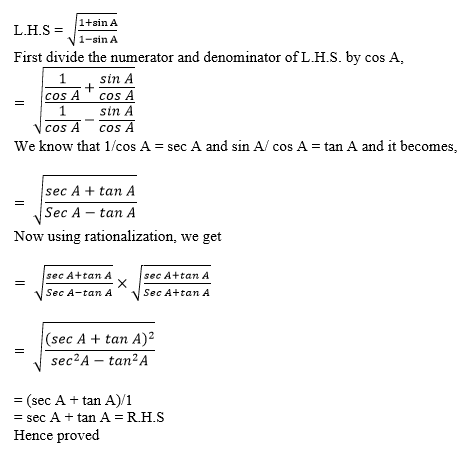
(i) √[1 + sinA/1 – sinA] = sec A + tan A
(ii) (1 + tan2A/1 + cot2A) = (1 – tan A/1 – cot A)2 = tan2A
Solution:
(i) Given:√[1 + sinA/1 – sinA] = sec A + tan A
(ii) Given: (1 + tan2A/1 + cot2A) = (1 – tan A/1 – cot A)2 = tan2A
LHS:
= (1+tan²A) / (1+cot²A)
Using the trigonometric identities we know that 1+tan²A = sec²A and 1+cot²A= cosec²A
= sec²A/ cosec²A
On taking the reciprocals we get
= sin²A/cos²A
= tan²A
RHS:
=(1-tanA)²/(1-cotA)²
Substituting the reciprocal value of tan A and cot A we get,
= (1-sinA/cosA)²/(1-cosA/sinA)²
= [(cosA-sinA)/cosA]²/ [(sinA-cos)/sinA)²] = [(cosA-sinA)²×sin²A] /[cos²A. /(sinA-cosA)²] = sin²A/cos²A
= tan2A
The values of LHS and RHS are the same.
Hence proved.
Question 12: If sin θ + cos θ = √3, then prove that tan θ + cot θ = 1.
Solution:
Given,
sin θ + cos θ = √3
Squaring on both sides,
(sin θ + cos θ)2 = (√3)2
sin2θ + cos2θ + 2 sin θ cos θ = 3
Using the identity sin2A + cos2A = 1,
1 + 2 sin θ cos θ = 3
2 sin θ cos θ = 3 – 1
2 sin θ cos θ = 2
sin θ cos θ = 1
sin θ cos θ = sin2θ + cos2θ
⇒ (sin2θ + cos2θ)/(sin θ cos θ) = 1
⇒ [sin2θ/(sin θ cos θ)] + [cos2θ/(sin θ cos θ)] = 1
⇒ (sin θ/cos θ) + (cos θ/sin θ) = 1
⇒ tan θ + cot θ = 1
Hence proved.
Question 13: Express cot 85° + cos 75° in terms of trigonometric ratios of angles between 0° and 45°.
Solution:
cot 85° + cos 75°
= cot (90° – 5°) + cos (90° – 15°)
We know that cos(90° – A) = sin A and cot(90° – A) = tan A
= tan 5° + sin 15°
Question 14: What is the value of (cos267° – sin223°)?
Solution:
(cos267° – sin223°) = cos2(90° – 23°) – sin223°
We know that cos(90° – A) = sin A
= sin223° – sin223°
= 0
Therefore, (cos267° – sin223°) = 1.
Question 15: Prove that (sin A – 2 sin3A)/(2 cos3A – cos A) = tan A.
Solution:
LHS = (sin A – 2 sin3A)/(2 cos3A – cos A)
= [sin A(1 – 2 sin2A)]/ [cos A(2 cos2A – 1]
Using the identity sin2θ + cos2θ = 1,
= [sin A(sin2A + cos2A – 2 sin2A)]/ [cos A(2 cos2A – sin2A – cos2A]
= [sin A(cos2A – sin2A)]/ [cos A(cos2A – sin2A)]
= sin A/cos A
= tan A
= RHS
Hence proved.

No comments:
Post a Comment